09-03-2026
Seminario de Investigación: Synaptic architectures of the human temporal cortex.
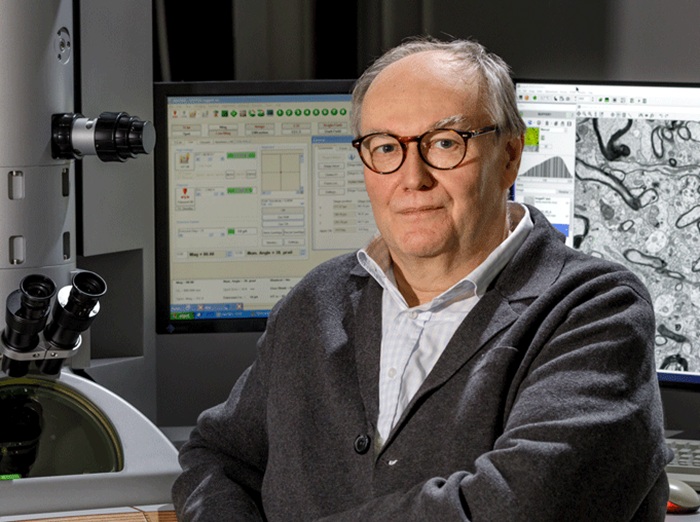
Prof. Joachim Lübke, Institute for Neuroscience and Medicine Jülich Research Center, Alemania
Titulo: Synaptic architectures of the human temporal cortex.
Bio: El profesor Joachim Lübke, Profesor de Investigación del Instituto de Neurociencia y Medicina de Jülich (Renania del Norte-Westfalia, Alemania), ha perseguido el objetivo de crear modelos 3D de alta resolución de las sinapsis en el cerebro humano. Durante mucho tiempo, estos diminutos puntos de contacto entre las células nerviosas solo podían estudiarse con modelos animales. Las estructuras son tan diminutas que ya no pueden visualizarse con un microscopio óptico, sino únicamente con un microscopio electrónico. Así, el Dr. Lubke, junto con su equipo y colaboradores, ha publicado los primeros modelos cuantificables de sinapsis en la corteza cerebral humana. Los resultados revelaron diferencias significativas entre humanos y animales, así como entre hombres y mujeres.
Summary: Synaptic boutons are fundamental building block connecting neurons in any given brain network. In contrast to experimental animals still rather little is known about these structures in the human brain, in particular their quantitative morphology. Using fine-scale transmission electron microscopy, serial ultrathin sections and 3D-volume reconstructions quantitative 3D-models of synaptic boutons were generated. The final goal was to describe the synaptic organization of the cortical column, layer by layer, using the human temporal lobe neocortex as a model system. We can demonstrate similarities but also marked layer-specific differences, in particular for the three pools of synaptic vesicles, namely the readily releasable, the recycling and resting pools. In addition, astrocytes formed a dense network in all layers although significant layer-specific difference in their contribution to the total volume of the neuropil and in the constitution of the ‘tripartite’ synapse were observed. In conclusion, synaptic boutons in the human temporal lobe neocortex like their counterparts in experimental animals represent ‘unique’ entities perfectly adapted to the ‘job' they have to fulfill in a given brain network.
What scenario exist in a pathological epileptic brain? Temporal lobe epilepsy, the most common type of refractory epilepsy is accompanied by severe structural alterations causally related to the degree and duration of the epilepsy. In two patients the superficial part of the neocortex is replaced by a massive astrocytic scar containing severely fragment synaptic complexes whereas the synaptic organization of the supragranular layers remained unaltered. In a third case, which was younger in age with a shorter duration of epilepsy the typical six-layered structure of the neocortex was existent and the synaptic organization remained intact.
Dia y hora. Lunes 9 de marzo, 11.30h
Lugar: Seminario 4
PDF